



Just after the end of WW2 Victor Vasarely started establishing a new artistic movement inspired by his influences at the time, stemming from the Abstract Expressionism and the Bauhaus style. The vibrant artistic environment in Paris of this period was the perfect background for the development of new creative outbursts. The main idea behind the optical art was the generation of a fluctuating and dynamic effect on a painting through the juxstaposition of contrasting colours and geometrical patterns.
His initial paintings were making use of contrasts between black and white geometrical shapes, as in his composition Supernovae, exhibited at the Tate Modern. Considered one of the leaders of the op art movement, Vasarely started experimenting in the 1930s with perspectives, textural effects, shadows and light to render optical illusions. Supernovae is a typical example of Optical Art, realised just using black and white and geometrical shapes to obtain the illusion of a tridimensional effect on the canvas.
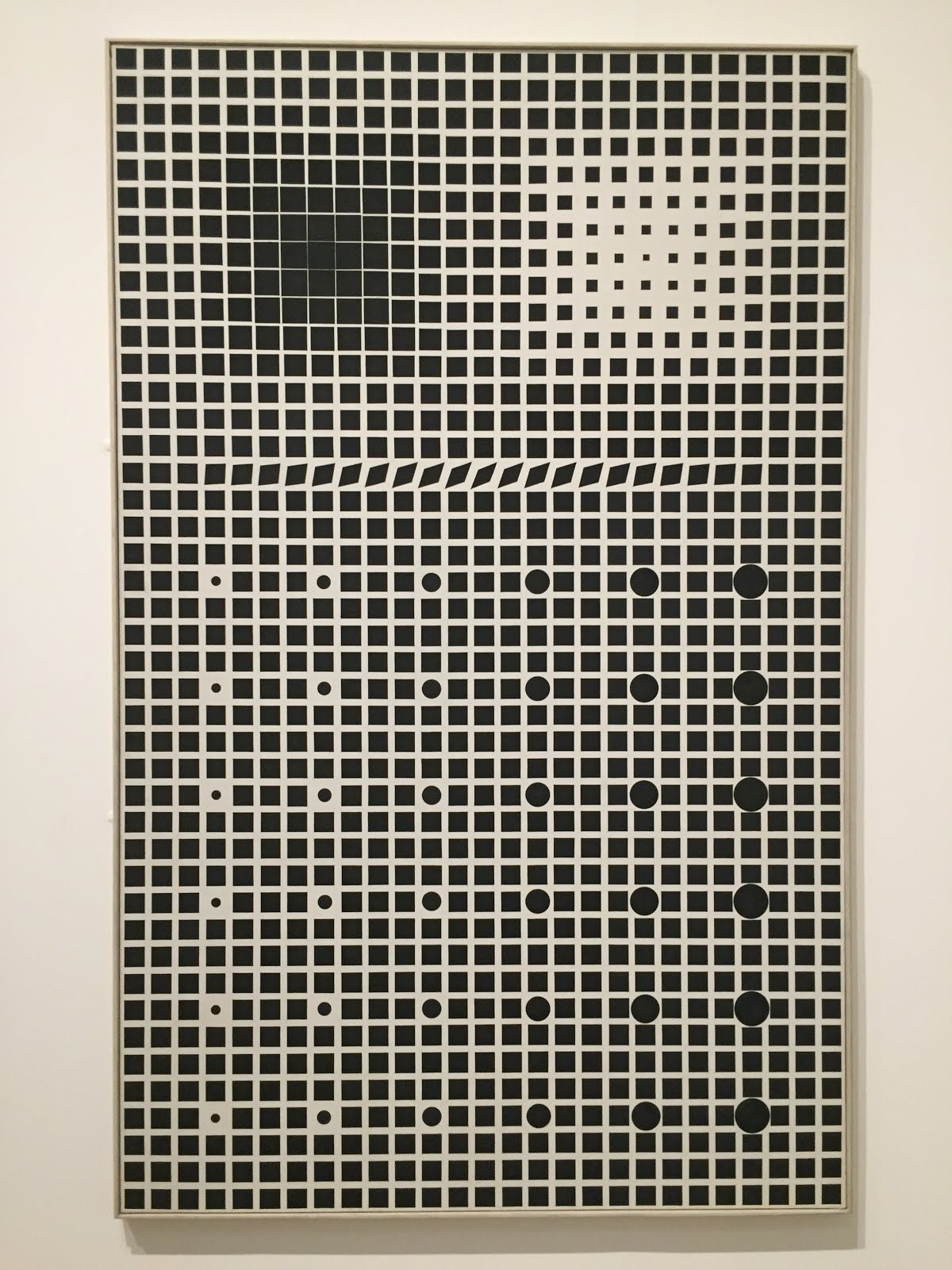
In a later phase of his artistic career Vasarely used also colours to add further dimensional effects to his compositions. Feny, featured in this article is an example of how he mastered his creative techniques with even more astonishing effects. Interestingly enough, his son, artistically known as Yvaral, also followed in the same artistic footsteps with optical art paintings like Ambiguous Structure n. 92 that elaborate more on the optical illusion achieved through the contrast of geometrical shapes and colours.
🇪🇸 Justo después del final de la Segunda Guerra Mundial, Victor Vasarely comenzó a establecer un nuevo movimiento artístico inspirado en sus influencias en ese momento, proveniente del expresionismo abstracto y el estilo Bauhaus. El vibrante ambiente artístico en París de este período fue el escenario perfecto para el desarrollo de nuevos estallidos creativos. La idea principal detrás del arte óptico fue la generación de un efecto fluctuante y dinámico en una pintura a través de la yuxtaposición de colores contrastantes y patrones geométricos.

Sus pinturas iniciales hacían uso de contrastes entre formas geométricas en blanco y negro, como en su composición Supernovae, expuesta en la Tate Modern. Considerado uno de los líderes del movimiento de op art, Vasarely comenzó a experimentar en la década de 1930 con perspectivas, efectos de textura, sombras y luz para representar ilusiones ópticas. Supernovae se un ejemplo típico de arte óptico, realizado simplemente usando formas geométricas y en blanco y negro para obtener la ilusión de un efecto tridimensional en el lienzo.
En una fase posterior de su carrera artística, Vasarely también utilizó colores para añadir más efectos dimensionales a sus composiciones. Feny, que aparece en este artículo, es un ejemplo de cómo dominó sus técnicas creativas con efectos aún más asombrosos. Curiosamente, su hijo, artisticamente conocido como Yvaral, también siguió los mismos pasos artísticos con pinturas de arte óptico como Ambiguous Structure n. 92 que elaboran más sobre la ilusión óptica lograda a través del contraste de formas geométricas y colores.

Discover more from Words, Colours and Notes
Subscribe to get the latest posts sent to your email.
One thought on “Feny, by Vasarely 🔳🔲◼️”