



Philadelphia Museum of Art


The Museum collection started in the aftermath of the celebrations marking the 100th anniversary of the Declaration of Independence with the Centennial Exposition in Philadelphia 1876. European and Japanese fine and decorative art objects and books for the museum’s library were among the first donations. In 1892 Anna H. Wilstach bequeathed a large painting collection, including many American paintings, and an endowment of half a million dollars for additional purchases. I have never been to the Museum in Philadelphia but I went to an exhibition at Palazzo Reale in Milan which presented a good section of the European painting collection, with a focus on impressionism and avant-garde.
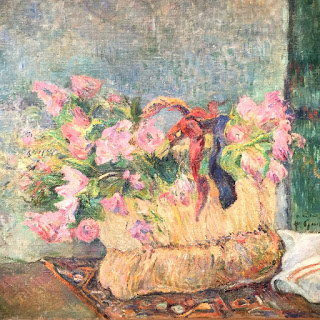
In the picture above, Still Life with Moss Roses in a Basket, oil painting by Paul Gauguin, 1884 – This delicate floral composition is still influenced by impressionist paintings and was painted by Gauguin following a difficult visit to his wife’s family in Denmark and his decision to dedicate his life to painting. Later his art will be influenced by primitivistic and symbolist themes.

Manne-Porte, Étretat, Claude Monet, 1885
Manet-Porte, Étretat (1885), part of the Philadelphia Museum of Art’s collection, exemplifies Claude Monet’s mature engagement with the Normandy coastline. Monet visited Étretat with his family at the end of the 1885 season, working across numerous canvases simultaneously to capture shifting light . The composition’s power lies in its withheld horizon: the cliff-top perspective creates a dizzying view down onto the water, its hazy light dissolving the boundary between sea and sky . This absence destabilizes conventional pictorial space, replacing it with atmospheric ambiguity.
Monet reserves his most energetic brushwork for the foreground, where crisscrossing strokes animate the sea and thick ridges of white paint mark waves breaking against rock . That contrast—gestural, tactile foreground against the cliff’s more solid mass—stages a dialogue between geological permanence and oceanic flux, a recurring Impressionist preoccupation. The painting reads less as topographical record than as a meditation on perception itself, isolation, and the sublime indifference of natural monument to human witness.

Van Gogh’s Sunflowers (1889, oil on canvas, 92.4 × 71.1 cm) is among the most critically significant works in the Philadelphia Museum of Art’s permanent collection. A copy of the Munich version — featuring fourteen blooms set against a distinctive turquoise-blue background — it was painted by Van Gogh in January 1889 as a replica of one of his most successful Arles compositions. The turquoise ground distinguishes it chromatically from its yellow-background London counterpart, producing a cooler, more psychologically complex tonality. The twelve flowers pulse with angular energy, their agitated contours reflecting an almost anthropomorphic vitality. Rather than mere botanical illustration, the work enacts Post-Impressionist principles: form is subordinated to expressive urgency, and pigment itself becomes emotional language. The impasto surface, applied with characteristic directional intensity, transforms still life into psychological self-portrait.

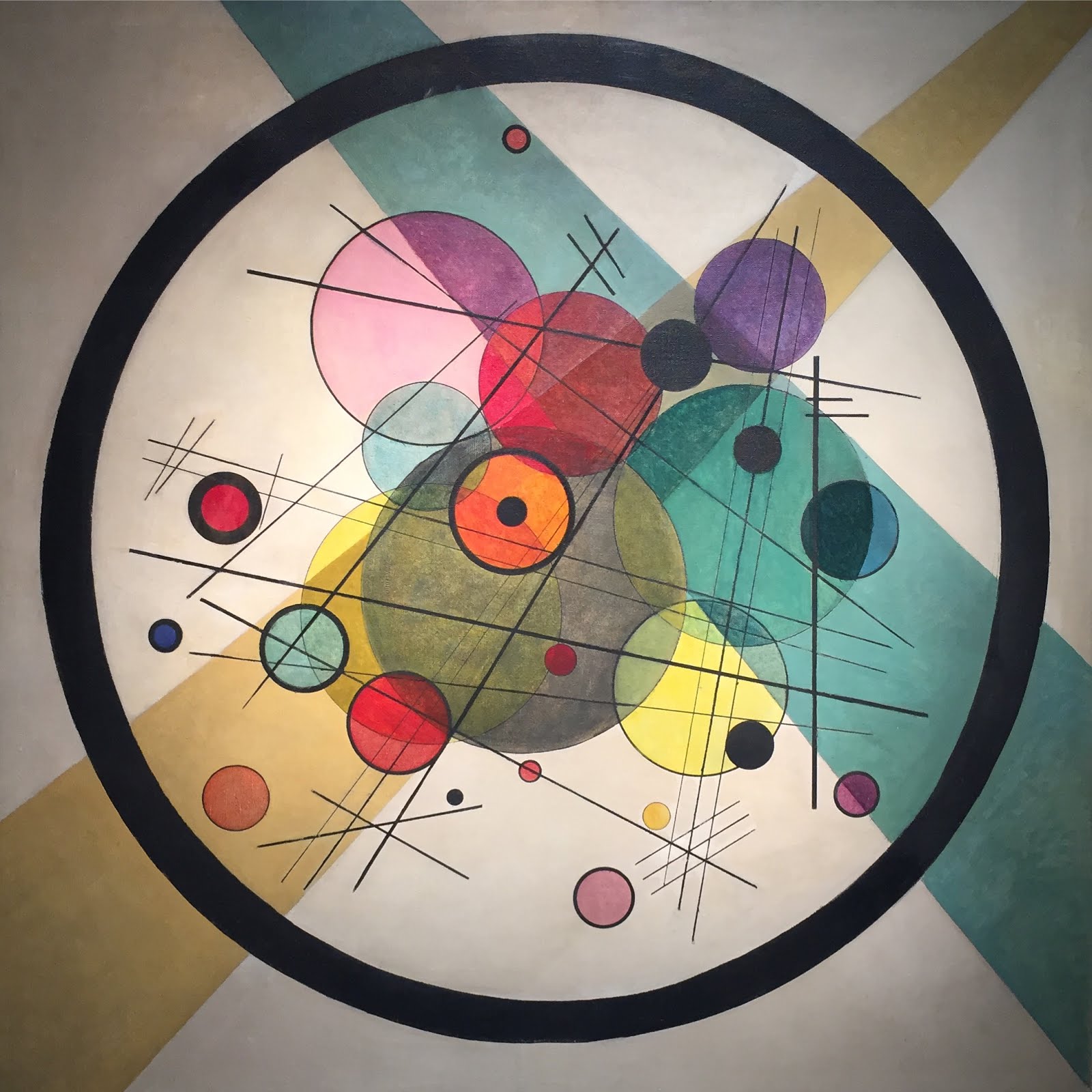
Circles in a Circle, is an oil painting by Wassily Kandinsky, 1923, exhibited at Palazzo Reale in Milan for the temporary exhibition Impressionism and Vanguards, This is an abstract composition against a white background, based around one big black-rimmed circle and two beams of coloured light across the canvas that change colours when intersecting other smaller coloured circles in the middle of the artwork.
Woman with Children, oil painting by Pablo Picasso, 1961 – In this painting Picasso portrays his family at the time, with his new wife, Jacqueline Roque, in the middle, sided by his daughter from a previous marriage, Paloma, on the left, and Cathy, Jacqueline’s daughter from a previous marriage, shown faceless on the right. Picasso had married Jacqueline the previous month.


You can follow me also on my other social media channels:
and subscribe to email updates from this blog:
Discover more from Words, Colours and Notes
Subscribe to get the latest posts sent to your email.
Art 🌻❣
Have a nice week! 😊
Likewise .🌻Stay blessed.
I enjoyed the tour Enzo! It’s so interesting the stories that are behind these artworks. But then, when you say Paul Gauguin was inspired after a difficult visit to his wife’s family, does it mean they hated him or was someone sick? Please, if you can tell I’ll like to know.
Thanks for your comment that allows me to explain better what happened to Paul while he was in Copenhagen. He had moved there from Paris to stay with his wife’s parents. He was a salesman but did not speak Danish and this meant an unsuccessful attempt to earn some family income. His wife became the breadwinner in the family as she was teaching French. He wanted to become a full time painter but could not do it in Denmark. The resolution to this situation was for him to leave his family, wife and five children in Copenhagen while he returned to Paris. This must have been a very difficult decision for him and can imagine how much he was troubled about it. Despite this background, his painting is so delicate and serene. He really loved painting, in contrast with the rest of his life. He found the happiness there he could not find anywhere else. His artistic soul was blossoming like the flowers he was painting.
Thanks so much for the information Enzo. Thank you!
It’s my pleasure to satisfy people’s curiosity
Thanks again.