



Celebrating the 95th birthday of Bridget Riley, born on April 24, 1931, pioneer of optical art
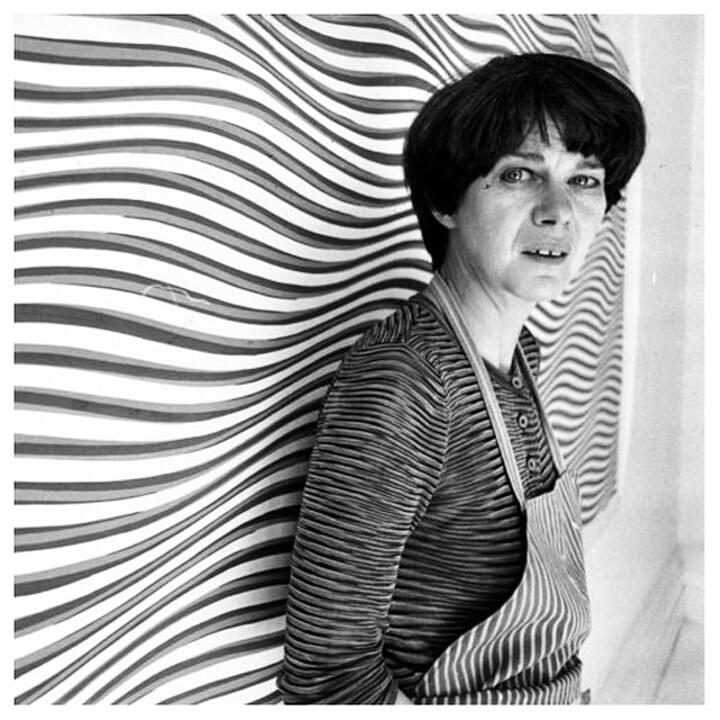
On April 24, art enthusiasts around the world celebrate the birth of Bridget Riley, a revolutionary painter whose innovative work played a pivotal role in the establishment of Op Art. Riley’s daring and fascinating creations captivated the public for decades, leaving an indelible mark on the world of contemporary art.
Bridget Riley is a contemporary British artist known for her experimentation with optical art and the use of geometric shapes and solid colour. Around 1960, he began to develop his distinctive style of black and white geometric patterns that take advantage of the dynamic effects on the human eye of contrasting juxtaposition.

Bridget Riley: Visionary of Op Art’s Pulse
As an art blogger hooked on perceptual magic, I can’t get enough of Bridget Riley’s oeuvre. This British trailblazer ignited the Op Art movement in the 1960s with black-and-white geometric patterns that tricked the eye into seeing motion—think Movement in Squares (1961), where squares undulate like a living grid. Her early works drew from Pointillism and Seurat, evolving into hypnotic stripes and waves that exploit color contrasts for illusions of depth and flow.
By the late ’60s, Riley exploded into color with stripe paintings like Fission (1963), blending vivid hues to evoke rhythmic vibrations. The 1970s brought “curve” paintings—Gala (1974), Entice II (1974)—with undulating lines mimicking nature’s organic sway, followed by “slant” and “ellipse” series exploring light and space. Recent decades feature luminous compositions like Concerto 1 and 2 (2020s), nodding to Impressionists via optical mixtures of jewel tones.
Riley’s production spans over 650 paintings, prints, drawings, and murals, cataloged in exhaustive raisonnés, blending rigor with emotional resonance—peaceful yet disorienting. Major works grace permanent collections: Tate Britain showcases Concerto duo and stripes in its modern British galleries. National Gallery, London, holds key pieces from her 2010-11 show; David Zwirner rotates mid-career gems; and the National Galleries of Scotland feature ongoing displays post-2019 retrospective. Spot Dominion (1977) at MoMA, New York, or curves at Yale Center for British Art. Currently, catch her Starting Point solo at Musée d’Orsay, plus Tate Britain’s staples.
Her major paintings
Movement in squares is a first work of seminal art by Riley considered a twist in abstraction with geometric shapes. Rhythmic and repeated squares are compressed into an escape line, giving the impression of dynamic movement. Riley wrote about how this work of art was born from an experimental drawing, since something happened “in the paper he had not foreseen.”
Bridget Riley embarked on her artistic journey in a time of great experimentation and exploration in the art world. Graduated from Goldsmiths College and the Royal College of Art, Riley initially experimented with figurative and abstract styles before finding her true vocation in Op Art. It was during the 1960s when Riley began producing the iconic black and white geometric paintings that would define her career and influence generations of artists to come.
Op Art, short for Optical Art, is a movement characterised by the use of optical illusions and geometric patterns to create dynamic and visually appealing compositions. Riley’s mastery of this technique is evident in works such as “Movement in Squares” and “Fall”, where carefully organised lines and shapes seem to pulsate and change before the eyes of the viewer. Through meticulous attention to detail and precision, Riley created works of art that challenged perceptions of space, form and movement.

One of Riley’s most famous works is “Blaze 1”, a large-scale painting that shows his mastery of colour and form. In this piece, vibrant shades of red, orange and yellow interact with black and white geometric patterns to create a sense of movement and energy. The dynamic composition attracts the viewer, inviting him to explore the interaction between light and colour.
Riley’s influence extends far beyond the screen, as she played a crucial role in the popularisation of Op Art on the international scene. His participation in major exhibitions such as “The Responsive Eye” at the Museum of Modern Art in New York brought Op Art to a wider audience, causing a global fascination with the movement. Riley’s innovative approach to art creation inspired numerous artists to experiment with optical illusions and geometric abstraction, shaping the course of contemporary art in the process.

Nataraja is a painting inspired by a trip to India and the vibration of local folk art, now exhibited at the Tate Modern. The variety, balance and complexity of the colours are incredible, with up to 20 shades of a colour on the entire screen you can choose the colours you like best. The title refers to the Hindu god Shiva, as Lord of Dance, with his many arms, rendered in canvas with contrasting colours and geometric and dynamic shapes, typical of optical art.
In addition to her artistic achievements, Bridget Riley’s contributions to the art world were recognised with numerous awards and honours. She was named Commander of the Order of the British Empire (CBE) in 1979 and was later awarded the prestigious Praemium Imperiale of Painting in 2012. Riley’s enduring legacy continues to inspire artists and art lovers, reminding us of the power of creativity to transcend borders and challenge perceptions.

As we celebrate Bridget Riley’s birthday, let’s take a moment to appreciate her innovative contributions to the art world. Through her pioneering work in Op Art, Riley exceeded the limits of visual expression, inviting us to see the world in new and unexpected ways. His legacy serves as a testament to the lasting power of artistic vision and innovation, inspiring generations to explore the unlimited possibilities of the creative mind.
Evoë 3 is a large horizontal painting, made on two adjacent canvases, which was created with irregular curved shapes using four solid and contrasting colours: green, blue, pink and white. This creative approach is a characteristic aspect of optical art.


Essential online references
Here are the most relevant online bibliographic references for British painter Bridget Riley, selected from authoritative art foundation sites and publisher pages. These focus on comprehensive catalogues raisonnés, collected writings, and exhibition monographs that catalog her oeuvre.
Bridget Riley”s profile at Tate
Artisti biography and list of her artworks part of the permanent collection of Tate Modern.
Bridget Riley’s entry at Britannica
Encyclopaedic entry for Bridget Riley in the online version of Britannica.
Complete Paintings Catalogue
This page details Bridget Riley: The Complete Paintings (2018), a five-volume set edited by Robert Kudielka with Alexandra Tommasini and Natalia Naish, compiling over 650 works from 1940s–2017 with high-quality illustrations, notes, essays on studios and methods, and an illustrated biography.
Complete Prints – Catalogue
The Bridget Riley Art Foundation lists Bridget Riley: The Complete Prints 1962-2020 by Bridget Riley, Lynn MacRitchie, Craig Hartley, Robert Kudielka, and others, covering her print works comprehensively.
Collected Writings 1965-2009
This publisher page describes The Eye’s Mind: Bridget Riley, Collected Writings 1965-2009, edited by Robert Kudielka, featuring her essays and interviews on color, perception, art history, Seurat, Cézanne, Mondrian, and more.
Works 1981–2015 Monograph
David Zwirner Books presents Bridget Riley: Works 1981–2015 (2016) with texts by Robert Kudielka and Richard Shiff, showcasing paintings and works on paper from her rich mid-to-late career period, including stripe works and a return to black-and-white.
Bridget Riley and the birth of Op Art
This overview page from the Unit London provides an overview of the artistic production of Bridget Riley and the birth of Op Art.
Articles on Bridget Riley in other languages in this blog:


You can also follow me on my other social media channels:
And subscribe to email updates from this blog:
Discover more from Words, Colours and Notes
Subscribe to get the latest posts sent to your email.