



Celebration of the 142nd anniversary of the birth of Amedeo Modigliani, born on 12/7/1884
Born in Livorno on July 12, 1884, Amedeo Modigliani worked as a painter and sculptor mainly in France. After spending his youth and his first artistic career between Tuscany and Venice, Modigliani moved to Paris in 1906, where he came into contact with artists such as Pablo Picasso and Constantin Brancusi. His first artistic goal was sculpture with the realization of highly stylized portraits and complete figures that were not very appreciated by his contemporaries, but that only became popular after his death. Of its vast artistic production for a relatively short period, only a part remains because most of it was destroyed by the artist, who considered it inferior, or ignored by its initial owners,

Amedeo Modigliani, known for his modernist paintings, was also a sculptor of immense talent. His sculptures, characterized by elongated figures and simplified shapes, reflect his distinctive style that merged perfectly with the artistic trends of Paris at the beginning of the 20th century. Although Modigliani is famous mainly for her paintings, her sculptures are equally important to enhance her artistic feat. Influenced by ancient African and Mediterranean art, Modigliani’s sculptures present a unique mixture of traditional and avant-garde elements. Modigliani’s sculptures usually have elongated shapes that convey a feeling of elegance and grace. The lengthening not only underlines the inherent beauty of the human figure, but also adds an element of abstraction to his works. Through this stylistic choice, Modigliani sought to capture the essence of modernity, while preserving a certain timeless quality. In addition to their aesthetic appeal, Modigliani’s sculptures also reflect the artist’s exploitation of different materials.
He experimented with several mediums, such as stone, wood and clay, to bring his artistic vision to life. This versatility further highlights Modigliani’s ability to adapt his skills as a painter and sculptor. Modigliani’s sculptures were not widely recognized during his lifetime, but they were widely acclaimed posthumously. Today, they are revered as masterpieces that illustrate the artist’s unique contribution to modern art. In conclusion, Amedeo Modigliani’s talent extended beyond painting in the field of sculpture. Its elongated figures and simplified forms present a distinctive modernist style that fits perfectly into the artistic landscape of Paris at the beginning of the 20th century. Through his sculptures, Modigliani demonstrated an exceptional ability to capture beauty and abstraction while exploring diverse materials. These works continue to be celebrated as important contributions to the art world.
From 1914, Modigliani began to move from sculpture to painting, contributing to this art form elements of his previous experience and the artistic environment he lived in Paris. This generated a very personal style and some immediately recognizable images that distinguish him a lot from his contemporaries. His sense of color and shape, greatly influenced by Cézanne, and his elongated figures with tense necks became his artistic mark and a reference for future painters.
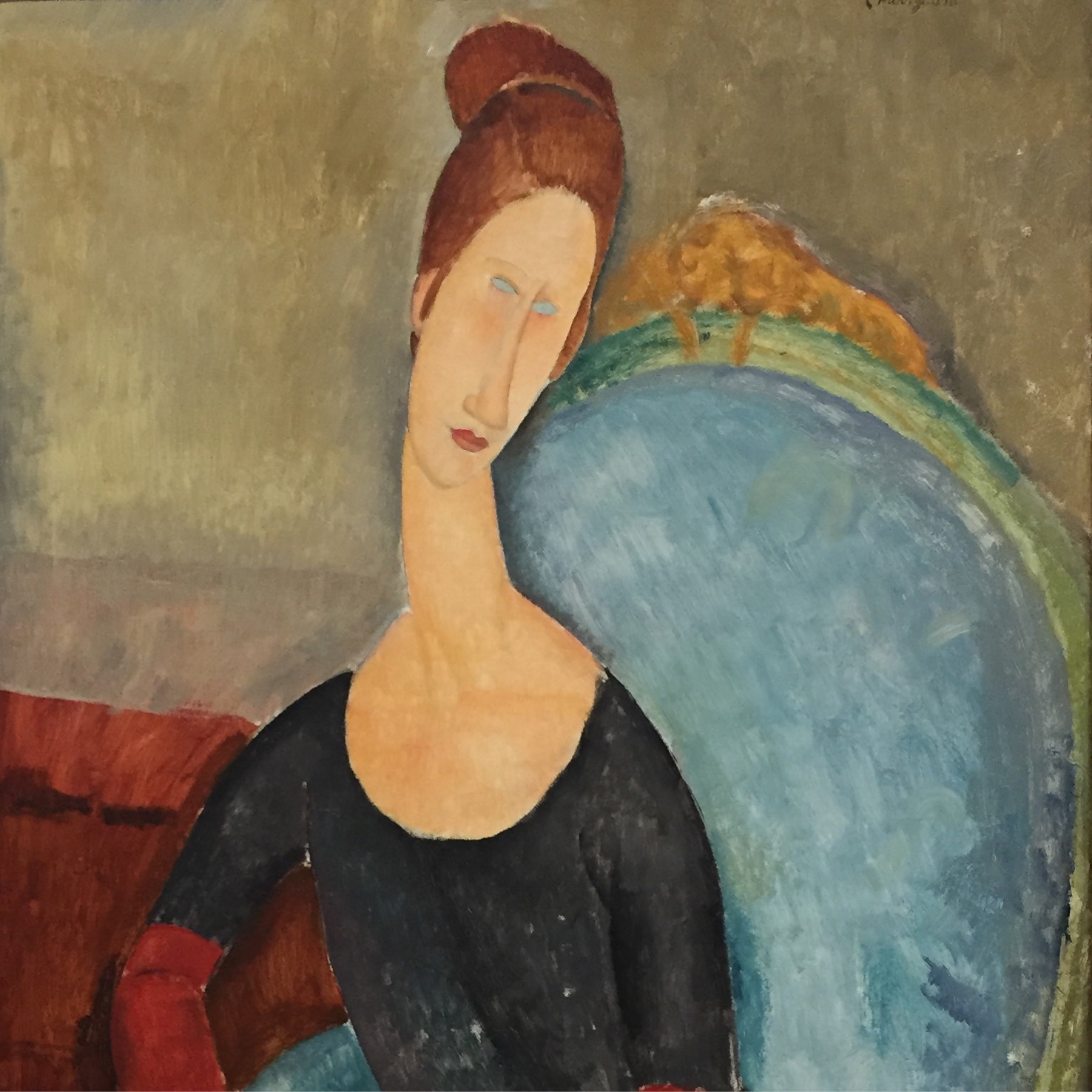
The portrait on the right is inspired by Jeanne Hébuterne, one of Modigliani’s favorite models and couples. She was an art student in Paris at the end of World War I. This portrait was probably painted in Paris, when Jeanne was pregnant with her daughter Amedeo, who was born in November 2018. The relationship between the two was very frustrated by his family and that’s probably why he committed suicide only two days after the death of his partner due to tuberculosis.
Modigliani is known for his modernist nudes. His paintings are usually portraits of women whose bodies stretch to underline their sensuality. The painter’s first works were influenced by the theme of the Italian painters with whom he studied in Florence, in particular Alessandro Filippini, who presented him with the works of Eugène Delacroix and encouraged him to be bolder in his use of color. In 1906, Modigliani went to Paris, where he met Pablo Picasso and Georges Braque, who later became two of his most important friends and artistic collaborators. In 1909 he returned to Italy, where he lived the rest of his life, alternating Rome and Milan. Nude lying with a blue pillow is an oil painting on canvas created in 1916. The painting is one of the dozens of nudes created by Modigliani between 1916 and 1919.
“Nu couché” (Desnudo reclinable, 1917-1918)
Description: “Nu couché” is perhaps Modigliani’s most famous work, which represents a naked woman reclining on a bed, her body gently curved and her gaze directly enveloping the viewer.
Analysis:
- Form and Composition: The composition stands out for its simplicity and elegance, emphasizing the elongated lines and curves that are characteristic of Modigliani’s style. The sensuality of the form is reinforced by the use of warm and earthy tones.
- Expression and Emotion: The direct gaze of the subject breaks the convention of passive female nudes, adding a layer of confrontation and agency. This look creates an intimate connection between the viewer and the subject.
- Influences: The painting reflects Modigliani’s deep interest in African art and Renaissance painting, evident in the elongated proportions and the sculptural quality of the figure.
- Impact: At that time, painting was controversial due to its explicit content, but since then it has been recognized as a masterpiece of modern art, celebrating the human form in a classic and revolutionary way.
2. “Jeanne Hébuterne with hat and necklace” (1917)
Description: This portrait features Jeanne Hébuterne, muse and lover of Modigliani, represented with a serene expression, with a hat and necklace.
Analysis:
- Form and Technique: The painting shows Modigliani’s distinctive elongated neck and face style, with simplified and elegant lines. The use of color is restricted but effective, focusing attention on Jeanne’s facial features and expression.
- Emotional depth: Jeanne’s portrait exudes a sense of quiet dignity and introspection. Her downcast eyes and delicate features convey a profound sense of melancholy and intimacy.
- Symbolism: The hat and necklace serve not only as fashionable elements, but also as symbols of Jeanne’s personality and the aesthetics of the time. The portrait captures not only his image, but his essence.
- Artistic context: This painting illustrates Modigliani’s exit from the chaotic and abstract tendencies of his contemporaries, favoring a more personal and expressive approach.
3. “Portrait of Pablo Picasso” (1915)

Description: This portrait of fellow artist Pablo Picasso is a compelling example of Modigliani’s ability to capture the essence of his subjects.
Analysis:
- Shape and style: The elongated neck and angular features are typical of Modigliani’s portraits. The silenced color palette and abstract but recognizable form highlight Modigliani’s unique synthesis of realism and stylization.
- Psychological vision: Picasso’s intense gaze and the slight tilt of his head suggest both introspection and a hint of arrogance, capturing the complex personality of the famous artist.
- Interpersonal dynamics: The painting reflects the mutual respect and competitive spirit between Modigliani and Picasso. It serves as a fascinating visual dialogue between two giants of art from the early 20th century.
- Artistic influence: This work illustrates Modigliani’s ability to portray not only the physical appearance, but the inner life of his subjects, differentiating him from his contemporaries.
Amedeo Modigliani’s main paintings, “Nu couché”, “Jeanne Hébuterne with hat and necklace” and “Portrait of Pablo Picasso”, exemplify his mastery of the portrait and human form. Through his different elongated lines, emotional depth and synthesis of influences, Modigliani created works that are timeless and deeply personal. His ability to capture the essence of his themes, whether through a sensual nude, a beloved muse or a fellow artist, continues to resonate with the viewers, ensuring his place as a central figure in modern art.
The peasant is part of a small group of paintings that Modigliani made as young people sitting in his studio in Nice and is now exhibited at the Tate Modern in London. The artist engraved the title of the work in the lower right corner of the canvas, identifying the model as a “peasant child”. However, there are some doubts about the accuracy of the title. The same model seems to appear in another table called “The young apprentice”. Modigliano had long been influenced by the painter Paul Cézanne and this painting was probably inspired by the images of Cézanne’s field workers. Cézanne’s themes were also placed in the center of the canvas and painted mainly in blue tones.
Essential online references
Here are 5 strong English-language bibliographic references on Amedeo Modigliani, with a short note on what each page contains:
- Britannica — Amedeo Modigliani: References & Edit History
A compact reference page that lists major biographies, catalogues raisonnés, and key studies on Modigliani, making it especially useful as a starting bibliography. It also highlights foundational works such as André Salmon’s early biography and later scholarly catalogues. - Britannica — Amedeo Modigliani
This biography gives a reliable overview of Modigliani’s life, style, and importance in 20th-century art. It is less a bibliography page than a general reference entry, but it is still useful for concise, authoritative background. - WebMuseum — Modigliani, Amedeo
This page offers a readable art-historical profile of Modigliani, including his Paris years, sculptural phase, and mature painting style. It is also rich in references to specific works and helps contextualize his artistic development. - Museo Nacional Thyssen-Bornemisza — Modigliani, Amedeo
A museum reference page that summarizes his biography, stylistic traits, and influences, including his move to Paris and his engagement with sculpture and African masks. It is useful for a concise institutional overview grounded in museum scholarship. - The Modigliani Project — Catalogue Raisonné
This is the most specialized reference here: a scholarly project centered on cataloguing and researching Modigliani’s work. It is especially valuable for bibliographic research because it focuses on attribution, documentation, and the catalogue raisonné framework.
For a blog bibliography, the first and fifth entries are the most directly useful, while the museum and encyclopedic pages are excellent for supporting context.
Posts about Amedeo Modigliani in other languages in this blog


You can also follow me on my other social media channels:
And subscribe to email updates on this blog:
Discover more from Words, Colours and Notes
Subscribe to get the latest posts sent to your email.